
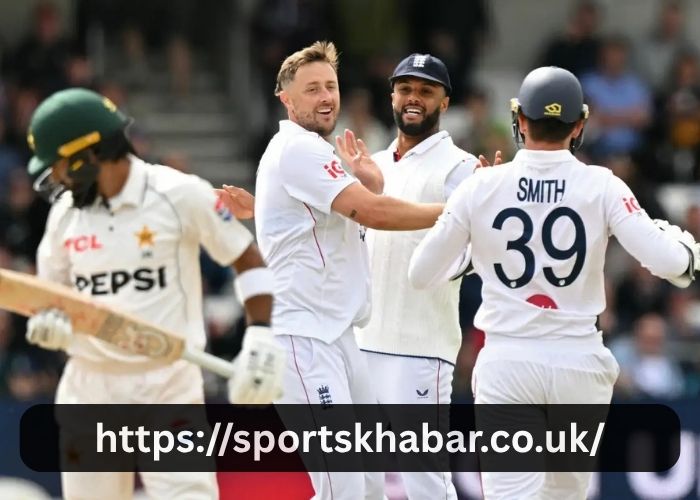
England cricket has been mired in misleadership ever since the four captains of 1988 were appointed, with Ben Stokes at the centre of yet another crisis caused by them themselves.
Root represents a more reliable captain choice than Stokes, who was known to make mistakes through his reckless approach to managing games. The England National Cricket Team has continued to rely on experienced leadership to maintain consistency and compete successfully across international formats.
| No. | Player | Role |
|---|---|---|
| 1 | Joe Root | Batter / Test Captain |
| 2 | Harry Brook | Batter |
| 3 | Ben Duckett | Batter |
| 4 | Zak Crawley | Opening Batter |
| 5 | Ollie Pope | Batter |
| 6 | Jamie Smith | Wicketkeeper-Batter |
| 7 | Jordan Cox | Wicketkeeper-Batter |
| 8 | Jacob Bethell | All-rounder |
| 9 | Jofra Archer | Fast Bowler |
| 10 | Gus Atkinson | Fast Bowler |
| 11 | Josh Tongue | Fast Bowler |
| 12 | Ollie Robinson | Fast Bowler |
| 13 | Brydon Carse | Fast Bowler |
| 14 | Shoaib Bashir | Spin Bowler |
| 15 | Rehan Ahmed | Spin Bowler |
| 16 | Sam Curran | All-rounder |
| 17 | Jos Buttler | Wicketkeeper-Batter |
| 18 | Adil Rashid | Spin Bowler |
| No. | Date | Opponent | Format | Venue | Result |
|---|---|---|---|---|---|
| 1 | Aug 19–23, 2026 | Pakistan | Test | Headingley, Leeds | England won by an innings & 103 runs |
| 2 | Jul 19, 2026 | India | ODI | Lord’s, London | England won by 27 runs |
| 3 | Jul 16, 2026 | India | ODI | Cardiff | England won by 4 wickets |
| 4 | Jul 14, 2026 | India | ODI | Edgbaston, Birmingham | India won by 6 wickets |
| 5 | Jul 11, 2026 | India | T20I | Southampton | England won by 56 runs |
| 6 | Jul 9, 2026 | India | T20I | Bristol | England won by 9 wickets |
| 7 | Jul 7, 2026 | India | T20I | Nottingham | England won by 125 runs |
| 8 | Jul 4, 2026 | India | T20I | Manchester | England won by 4 wickets |
| 9 | Jul 1, 2026 | India | T20I | Chester-le-Street | No Result — rain |
| 10 | Jun 25–29, 2026 | New Zealand | Test | Trent Bridge, Nottingham | New Zealand won by 160 runs |
Origins
Cricket, the global phenomenon that has taken the world by storm, traces back to England during the 17th Century. After becoming England’s national game during the 18th Century and spreading throughout their colonies. England became responsible for over arm bowling and one day cricket’s introduction; although Australia contributed equally.
Broadhalfpenny Down in Hampshire saw the first-ever recorded match take place in 1772 between Hambledon Club team from Hambledon and Hampshire sides – three surviving scorecards remain for this match, which began a continuous statistical record of cricket.
That same year also marked the inaugural county championship; during its reign until World War 1, it is widely known as “Golden Age of Cricket.” WG Grace and Wilfred Rhodes became among its star players.
In the 19th Century, an international cricket governing body known as the Imperial Cricket Conference (ICC) was created. England, Australia and South Africa joined this inaugural body as founding members with Marylebone Cricket Club being among its original associations.
Railway technology also contributed to cricket’s spread as it allowed teams to meet across vast distances without incurring long journey times between matches.
At the turn of the 19th and early 20th centuries, limited overs matches were introduced, signalling a new era. England emerged as a dominant power during this era and produced some of its greatest batsmen and bowlers of all time.
Television and the globalization of economies has propelled cricket’s popularity forward, leading to nearly one hundred countries and territories being full members of the International Cricket Council (ICC), but only twelve playing Test cricket currently.
Over time, cricket has evolved to include T-10 (Ten-10) games which last 90 minutes as well as Test matches which may last five days; additionally, the ICC offers an extensive development programme designed to create more national teams capable of competing at top levels of play.
Formats
England Cricket Team participates in three different formats at an international level: Test matches, One Day Internationals and Twenty20 Internationals.
Furthermore it competes in county Championship, Metro Bank One-Day Cup T20 Blast and The Hundred tournaments both men and women, in addition to competing within regional structures of women’s cricket and MCC University Teams for men.
The ECB recognizes that cricket is evolving, and have responded by creating The Hundred as an exciting new format of ODI and T20 cricket combined together on one day, with each team playing two matches during one day – to reach younger audiences and bring new fans into the sport.
However, some prefer more traditional forms of the game; one such long match dates back to 18th Century England as an eight-day affair and test matches were introduced early 20th Century England with five day matches being an endurance, technique, and temperament test that requires teams to adapt quickly under changing conditions.
Recently, the ECB has made great efforts to make cricket more engaging for younger audiences by revising ODI formats with extra overs and shorter innings; creating more thrilling finishes; as well as developing numerous innovative batting strategies and tactics designed to maximize scoring opportunities for all types of players.
As the new era of cricket continues to unfold, England must adapt in order to remain successful. Jos Buttler remains one of the premier batsmen in world cricket; having a strong top order will be essential to their success. Their bowling attack appears well balanced too with Jofra Archer providing an attacking threat when fully fit while Adil Rashid and Jeetan Patel provide variety in spin bowling attack.
Ben Stokes may retire from Test cricket in 2026, but the remaining squad appears well-balanced across all formats. Harry Brook is considered a future captain for England’s national side and can provide balance through his all-round skills. Tom Banton and Phil Salt can provide explosive batsmanship while Sam Curran and Jacob Bethell provide important all-round depth.
Best players
England cricket team has produced many iconic players throughout its history, making it difficult to single out one individual as the “best.” However, Ian Botham remains widely revered and remains popular today as someone who helped redefine and popularise English cricket for future generations.
As a prolific first-class cricketer, he amassed more than 60,000 runs over his career, taking over 1,000 wickets as well. An exceptional batsman capable of playing all formats of cricket he is widely considered one of the great English cricketers ever.
Cricket first gained popularity in England during the early 1300s, quickly becoming an essential pastime of upper middle classes and public schools alike. Later it would even become part of its culture!
By the 18th century, cricket had become a regular feature at universities and colleges throughout England. This led to the creation of the County Championship – still considered to be its pinnacle competition today.
England currently have an outstanding side comprised of some of the finest players in world cricket. Joe Root, Stuart Broad and Ben Stokes have all made significant contributions to England’s success in recent years, most notably winning both ICC World Cups. They even recently claimed a T20 World Cup victory as well!
History of the Ashes series
History of Cricket’s Great Rivalry | Ashes Rivalries is an intricate and often contentious history. It dates back to 1877 when an England touring team played two matches against full Australian XIs in what are considered the first Test matches; then in 1878 there was an Australia tour to England, during which series victory was achieved and from that point forward this rivalry became known as The Ashes Rivalry.
Plum Warner wrote the book How We Recovered the Ashes in 1903 to renew interest in this series and this led to it becoming an annual fixture on international cricket’s calendar – with its name becoming part of its heritage.
After WWII, England struggled to recover its standing. Nonetheless, post-war stability returned under players such as Len Hutton, Denis Compton, Fred Trueman and Jim Laker to provide stability after which their stocks increased dramatically under Ray Illingworth’s astute captaincy; further improvements came during 1970-71 and 1976-77 series victories to establish their dominance of Ashes series.
At this point, an unofficial trophy, consisting of a Waterford Crystal replicating the Ashes Urn was introduced, awarded to winners after each test match. Unfortunately, its original counterpart never left its place within MCC Museum at Lord’s and remains stored there today.
At times in the 2017-2018 Ashes series, both sides made mistakes that undermined their chances of victory. England struggled in all departments: their top order batsmen faltered while bowlers generally performed below expectations; Australia on the other hand boasted world-class players such as captain Steve Smith and vice captain David Warner but struggled due to an inferior middle and lower order performance.
Though many will be dismayed at the result of the Ashes, there were moments that demonstrated what this rivalry can achieve. At Optus Stadium, the away dressing room was probably at its euphoric best due to the pressure put upon players by both teams to perform.
The England National Cricket Team displayed great determination and intensity, with players acting with more verve than ever before and creating an atmosphere unlike anything seen previously.
This raised hopes that future Ashes series would avoid similar turmoil and continue to showcase the passion and competitive spirit of international cricket. The England and Wales Cricket Board is already exploring how best to avoid similar instances happening again.
Also Read : England Cricket Team Vs South Africa National Cricket Team Timeline