
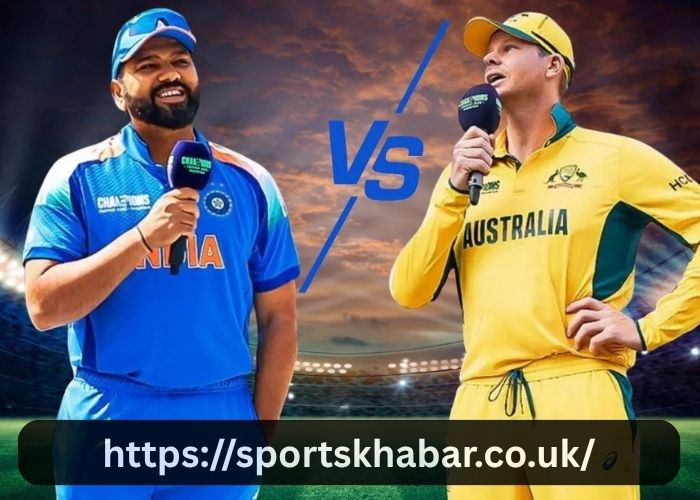
India and Australia share an enduring rivalry, having met at major ICC tournaments such as World Cups and Champions Trophies. This rivalry between the Australian Men’s Cricket Team Vs India National Cricket Team Timeline is considered one of the most competitive in international cricket.
Owen remains composed against Harshit Rana, striking four through cover before pulling to deep midwicket for six. However, Siraj saves that shot by accident!
| No. | Match | Format | Year | Result | Key Moment |
|---|---|---|---|---|---|
| 1 | Kolkata Test (Eden Gardens) | Test | 2001 | India won | Laxman 281, Dravid 180; India followed-on comeback |
| 2 | Gabba Test, Brisbane | Test | 2021 | India won | Pant’s 89* ended Australia’s 32-year Gabba unbeaten streak |
| 3 | World Cup Final, Johannesburg | ODI | 2003 | Australia won | Ponting 140* dominated India in final |
| 4 | T20 World Cup Semi-final, Durban | T20I | 2007 | India won | Yuvraj Singh’s explosive 70 off 30 balls |
| 5 | Adelaide Test | Test | 2018 | India won | India’s first-ever Test win in Adelaide in a tight match |
| 6 | World Cup Semi-final, Mohali | ODI | 2011 | India won | India chased down 260+ to reach final |
| 7 | Sydney Test | Test | 2004 | Draw | Tendulkar’s iconic 241* (retro innings) |
| 8 | Chennai Test (Tied Test era build-up) | Test | 1986 | Tied | One of the rare tied Tests in cricket history |
| 9 | World Cup Semi-final, Sydney | ODI | 2015 | Australia won | Australia outclassed India in knockout game |
| 10 | World Cup Final, Ahmedabad | ODI | 2023 | Australia won | Travis Head century crushed India’s hopes |
Test match
Australian Men’s Cricket Team Vs India National Cricket Team Timeline representing Australia in international tournaments. Based out of Melbourne, this squad has won more Test matches than any other nation ever has before and currently ranks number one globally; India-Australia rivalries remain one of the most intense and fierce in world cricket.
Australian cricket was established as an official national team in 1877, making them one of the oldest national cricket teams worldwide.
Their inaugural match against England at Melbourne Cricket Ground (MCG) in Melbourne saw them defeat them by 45 runs – this included Charles Bannerman, Jack Blackham, Billy Murdoch Fred Spofforth George Bonnor Percy McDonnell and George Giffen as batsmen who achieved this success. At that time the Australian team became known for its fierce fighting spirit and long innings of brilliant batting!
Australia was once a powerhouse in Test cricket, winning eight out of ten tours to England and South Africa during their Golden Age from 1897-98 through to 1910-11 South African tours, led by legendary players like Joe Darling and Clem Hill.
Australia was victorious against India during the 2023 Cricket World Cup, winning two out of the three matches played against each other, including their final match at Melbourne Cricket Ground (MCG).
These teams also met during numerous ICC Champions Trophy and World Cup tournaments played at senior levels – Australia taking home 10 victories while India claimed seven.
The Australian Cricket team is managed by a four-person board that works collectively in the interest of Australian cricket, led by Shawn Flegler as chairman.
Other current board members include Matthew Mott, Julie Hayes and Avril Fahey; they operate under Cricket Australia’s statutory rules to set policy, select and coach national team players as well as administer cricket across Australia in all forms and all regions – in addition to providing financial support to clubs and facilities around Australia.
| Role | Australia Players | India Players |
|---|---|---|
| Captain (Test/ODI/T20 mix) | Pat Cummins / Mitchell Marsh | Shubman Gill / Suryakumar Yadav |
| Opening Batters | Travis Head, David Warner (legacy), Jake Fraser-McGurk | Rohit Sharma, Shubman Gill, Yashasvi Jaiswal |
| Top Order Batters | Marnus Labuschagne, Steve Smith | Virat Kohli, Shreyas Iyer, KL Rahul |
| Middle Order | Glenn Maxwell, Marcus Stoinis, Tim David | Rishabh Pant, Hardik Pandya, Suryakumar Yadav |
| Wicketkeepers | Alex Carey, Josh Inglis | KL Rahul, Ishan Kishan, Sanju Samson |
| All-Rounders | Cameron Green, Marcus Stoinis, Glenn Maxwell | Hardik Pandya, Ravindra Jadeja, Axar Patel, Washington Sundar |
| Fast Bowlers | Pat Cummins, Mitchell Starc, Josh Hazlewood, Nathan Ellis | Jasprit Bumrah, Mohammed Siraj, Arshdeep Singh, Prasidh Krishna |
| Spinners | Adam Zampa, Matthew Kuhnemann | Kuldeep Yadav, Ravindra Jadeja, Yuzvendra Chahal (rotation) |
| Backup / Emerging Players | Xavier Bartlett, Matthew Short, Cooper Connolly | Tilak Varma, Rinku Singh, Abhishek Sharma, Ruturaj Gaikwad |
| Team Strength Style | Power pace attack + aggressive top order | Strong batting depth + spin variety |
ODI
One Day Internationals (ODIs) are an eleven player team format of cricket in which each bats and bowls for a set period. The International Cricket Council serves as its global governing body; captains who win the toss typically choose whether their side bats first, while overs are usually split into three powerplays of 10 overs each; with fielding restrictions placed upon bowling sides during these powerplays to prevent teams from fielding wholly defensive grounds during them.
Kerry Packer’s World Series Cricket competition introduced the one-day international (ODI) format of cricket in 1979, including uniformed players playing night matches under floodlights using white balls with dark sight screens for added contrast, multiple camera angles for television broadcasts and multiple camera angles to facilitate player injuries.
As a result, players became full-time professional athletes without needing outside employment to supplement their incomes.
In ODIs, the team that scores the most runs wins. To keep things straightforward and fair, each player receiving five points for every wicket taken earns five additional points when scoring more runs for their side; runs scored by these teams earn an extra point and up to 50 total points are available to a winning side with 100 being possible as maximum possible score.
Australia and India have met in ten ODIs so far, each winning six of them. At present they remain tied in their series; their next meeting will take place at Sydney Oval on Saturday – and its outcome could determine who takes home top honors at ICC Test Championship.
India’s initial innings was unimpressive, only managing to amass 221 all out from 50 overs. Nonetheless, they remain hopeful of winning the Adelaide Oval final match in high-scoring fashion with both teams looking for victory; Australia are favorites but India will fight hard for victory at home; both are currently second-ranked in Test Championship and aim to improve their standing with strong performances this time around.
T20I
The Twenty20 International (T20I) is a form of cricket played between international teams accredited by the ICC. Each innings lasts twenty overs, followed by an optional powerplay period.
Similar to traditional cricket, but featuring reduced deliveries per over and allowing up to two wickets lost per over, T20I differs by featuring single innings that only lasts twenty overs, along with mandatory powerplay periods and maximum two wicket losses per over.
Australia and India have long been two of the fiercest rivalries in world cricket, boasting an intense history of matches. Their fierce competition stems from a shared love for cricket as they fight for supremacy against each other at multiple ICC tournaments like ODI and T20 Champions Trophy tournaments.
India and Australia have competed in 304 T20I matches, with Australia winning 146 to India’s 114 victories. Both nations have also competed in several ICC World Cup and Champions Trophy matches; their head-to-head record in these competitions has been nearly equal, with both sides winning three out of their last four meetings.
Australia emerged victorious in their opening match against India by five wickets, led by Aaron Finch and Michael Clarke who performed exceptionally with their bats. Australia were able to dominate Indian bowlers while exerting immense pressure on Indian batsmen during this encounter.
On Saturday, Australia will play its final match of this series against South Africa and hope to seal it with a victory and secure top position in the table, giving them a shot at making it to the semi-finals of 2024 ICC World Cup.
T20 Internationals require that the winning team score eight runs in each Super Over to claim victory, using either countback or another Super Over where scores after five balls will determine who emerges victorious (similar to what occurs during Big Bash League matches).
If tied after either Super Over, countback will be used; otherwise the teams will play another Super Over where scores post fifth ball will determine who emerges victorious; should any tie persist, these methods will be applied again until someone emerges victorious; in case of tie, another Super Over will follow where scores after fifth ball will determine who emerge victor. In case of tie between two Super Overs if necessary – similar methods as seen during Big Bash League matches!
Bilateral T20 collection
Australia and India are two of the premier cricket teams worldwide. Over time they have met multiple times, most notably at an ICC tournament such as the 2023 ICC T20 World Cup final and multiple One Day International matches;
Both sides have emerged victorious although Australia has won more overall; in ODIs alone Australia has won 14 of 16 meetings while India won only nine. Their most recent T20I meeting took place in 2023 with Australia winning by 6 wickets.
Series between two nations are popular due to their combination of strategy and entertainment, drawing younger viewers. They help teams acclimatize to foreign conditions while testing themselves against various opposition styles.
Furthermore, these games serve as a foundational step towards future tournament success – helping establish international rankings as well as creating ongoing rivalries between the countries involved.
T20i bilateral series are an integral component of national cricket strategy, providing a structured environment in which players can develop their skills while maintaining competitive balance.
They also allow national teams to rotate squads regularly in order to strengthen both depth and bench strength as they prepare for multi-format competitions while building fan loyalty and international credibility.
Bilateral series can help nations strengthen ties, but should never serve as a replacement for international cricket. The Australian Men’s Cricket Team Vs India National Cricket Team Timeline fixture is a major example of this dynamic.
International football teams do not play friendly series against one another because this would take away from its ambition and excitement. Bilateral series should similarly be limited in number in order to maintain integrity of sport – keeping cricket relevant and exciting for fans around the globe.
| Format | Match | Venue | Result | Key Performers (Australia) | Key Performers (India) |
|---|---|---|---|---|---|
| ODI | 3rd ODI (Oct 2025) | Australia | Australia won series 2–1 | Matthew Short (runs), Adam Zampa (wickets) | Rohit Sharma (top scorer), Harshit Rana (wickets) |
| ODI | 2nd ODI (Oct 2025) | Adelaide | Australia won by 7 wickets (DLS) | Travis Head, Mitchell Marsh | Virat Kohli, KL Rahul |
| ODI | 1st ODI (Oct 2025) | Perth | India lost | David Warner (impact), Pat Cummins | Rohit Sharma, Shubman Gill |
| T20I | 5th T20I (Nov 2025) | Brisbane | No Result (series 2–1 India) | Tim David, Nathan Ellis | Abhishek Sharma, Suryakumar Yadav |
| T20I | 4th T20I (Nov 2025) | Gold Coast | India won by 48 runs | Glenn Maxwell, Adam Zampa | Axar Patel, Washington Sundar |
| T20I | 3rd T20I (Nov 2025) | Hobart | India won by 5 wickets | Marcus Stoinis, Tim David | Arshdeep Singh, Varun Chakravarthy |